Today’s society can be described as fragmented or broken through the reliance we have on technology to live our lives. Even though technology is needed in our lives, it can create a negative stigma.
Hyperreality is where a certain environment is made up or simulated to make up for a ‘broken’ world. Virtual Reality is a type of hyperreality which brings upon the allowance for someone to create their own new life, yet not real. Free for personalised customisation and ideation which is not allowed in the real world.
Due to the evolution of technology, hyperreality and simulation is becoming increasingly difficult to resist. Yet movies such as “Ready Player One’ gives us as an audience belief that simulated worlds can be resisted.
This link shows, with the increase of new technologies, that we are getting close to the world of Ready Player One, conveyed in the movie
Context behind memes and how they are used in Warfare
Memes are created as a way to personalise a topic and thus distribute the customised content across media, yet memes haven’t always been like this. Memes started off as a method of persuasion in the form of propaganda. In World War Two, Hitler used propaganda to persuade citizens to conform to his ideal and regime. This propaganda involves the use of words, or a caption, within an image forming posters and other propaganda types. This idea defines what a meme is today.
In this generation memes are customised and are subjective by creators to convey their opinion on a big issue or event. Memes in this generation started in the 2016 election between Clinton and Trump.
The role of remixing and the mashing up of content allows for subjective ideas in regard to the event or issue. Especially in the Trump v Clinton election, memes were used for viewer’s opinion on both of the candidates.
Networked Participation and Collective Intelligence
Producing content has significantly changed over the last decade. Producers of content has altered from being closed to open. These days you don’t have to be qualified to produce content nor have a reasonably large knowledge of the topic you are producing content about. The Audience can distribute content through ideating and customising, placing their own personalised view on the topic. Content based on a topic can be collectively distributed meaning that it will concur many different ideations. This coincides with network participation as when content is collectively distributed, a large network is involved and can all participate in creating their own personalised content.
My meme shows the weak or non existent nature of this generations gatekeeper. Dialogic Media allows for collective intelligence and network participation. Content is produced from many to many and is broadcasted directly, emphasising the weak gatekeeper. It is vastly open and allows for a metaphorical flood which destroys a highly populated city, or gatekeeper.
Here is a link which takes you to a site which provides an in-depth summary on gatekeeping in the media
This weeks lecture focused more on the way media can be created, in particular the use of the Emergent Media Paradigm.
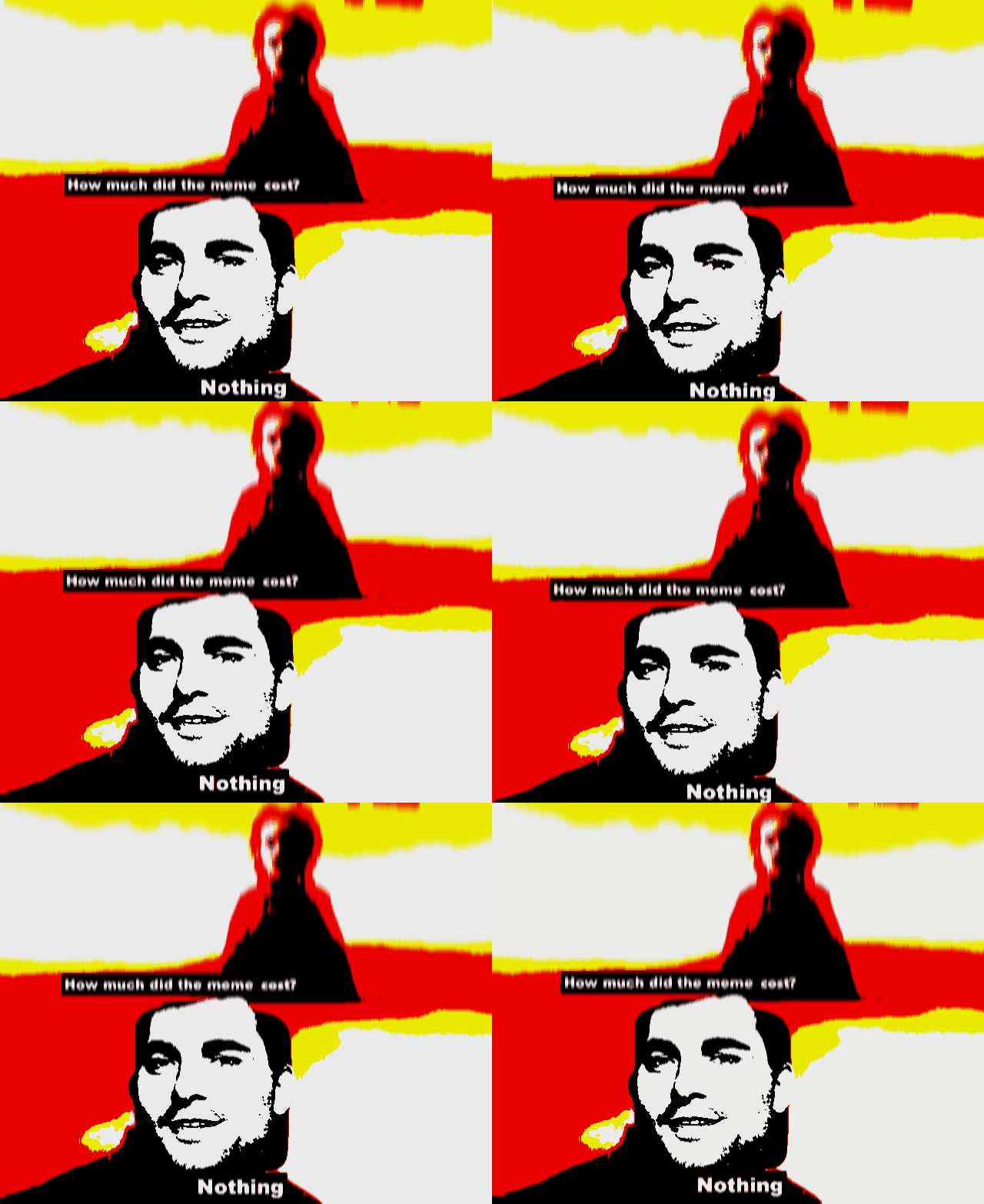
I made a gif which focused on the minimal or no cost of a meme to create, coming under the Emergent Media Economic Model. A Gif and Meme are at a low risk of failure and has no filter, unlike the Legacy Media Model which is filtered based on cost. Gifs allow for mass participation and interaction from the audience as they are usually based on trendy or topical, news or drama, around the world.
Memes and Gifs have definitely became a centre-point in this generation’s ever-changing media. This medium can be passed from individual to individual thus allowing for contrasting remediations and messages. My gif which is remediated from an avengers scene, permits for universal discussion as it is such a blockbuster film seen all over the world.
“Animals used in performances must be treated with respect, and not objectified, or subjected to indignity or ridicule.” – RSPCA
“Circuses. Elephants, tigers, and other animals that circuses use to entertain audiences do not stand on their heads, jump through hoops, or balance on pedestals because they want to. They perform these and other difficult tricks because they’re afraid of what will happen if they don’t.” – PETA
In this generation, with the increase of media and technology, the treatment of animals has become a serious issue. Animals in this day and age are used for multiples purposes. Whether its for sport, food or in this case entertainment.
For a while, the circus industry have had allegations towards them for their treatment of animals. Circus shows are constantly on the road, moving from city to city or even country to country. This means animals are constantly transported, sometimes in rugged and unstable cages, without a large consumption of food or water.
“Roll up, roll up, ladies and gentlemen, boys and girls for the crack of the whip against the animal’s stinging wounds”
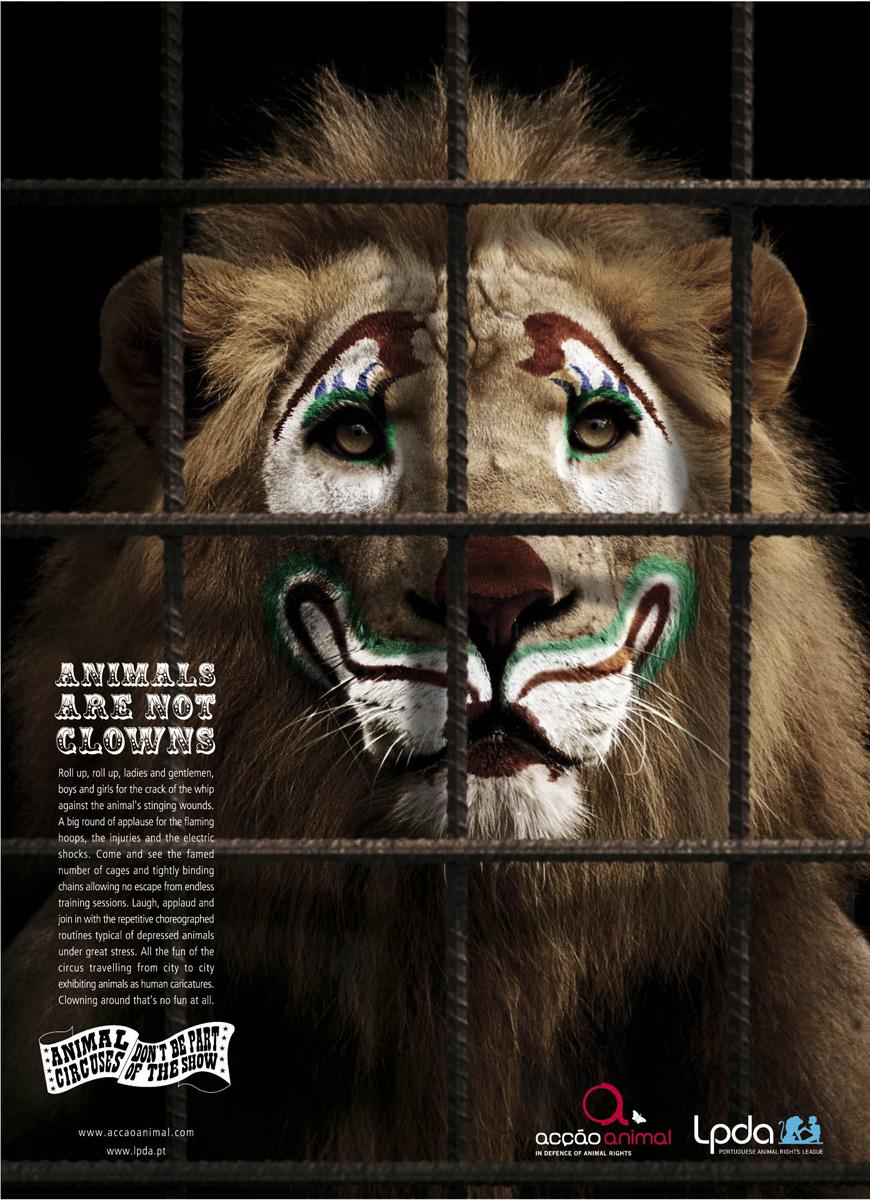
The advertisement, created by two Portuguese animal rights organisations: Acção Animal and Liga Portuguesa dos Direitos do Animal (LDPA), shows a lion with face paint meaning that it is used for the circus. Yet depending on which perspective you see this image from it may differ from the original denotation.
The denotation of “Animals are not clowns” literally means that animals are not meant to be treated like clowns. Yet the message may also connote another meaning. From my point of view, I see a lion who is imprisoned and exploited for the entertainment and leisure of people. The prison bars portray a tough and negative environment for the Lion enforcing the audience to immediately feel empathy, for not only the lions, but all the circus animals.
Conversely, the point of view from a Child’s perspective may contrast to my and others perspective. Face paint growing up conveys positive connotations as it was a novelty to have your face painted, showing a child’s involvement or support towards a team, event etc. When young children attend circus shows they tend to disregard the bigger issues involving the animals. In the show, the animals may seem to be happy or joyful, yet be tormented and treated poorly behind the scenes.
This issue portrayed in the advertisement allows for universal discussion in regards to the treatment of animals. Other aspects can be looked into further, for example the treatment of horses in horse racing or the treatment of greyhounds in greyhound racing. Yet as these two sports appear to be quite popular socially and financially, a discussion will most likely simmer down and be forgotten by most.
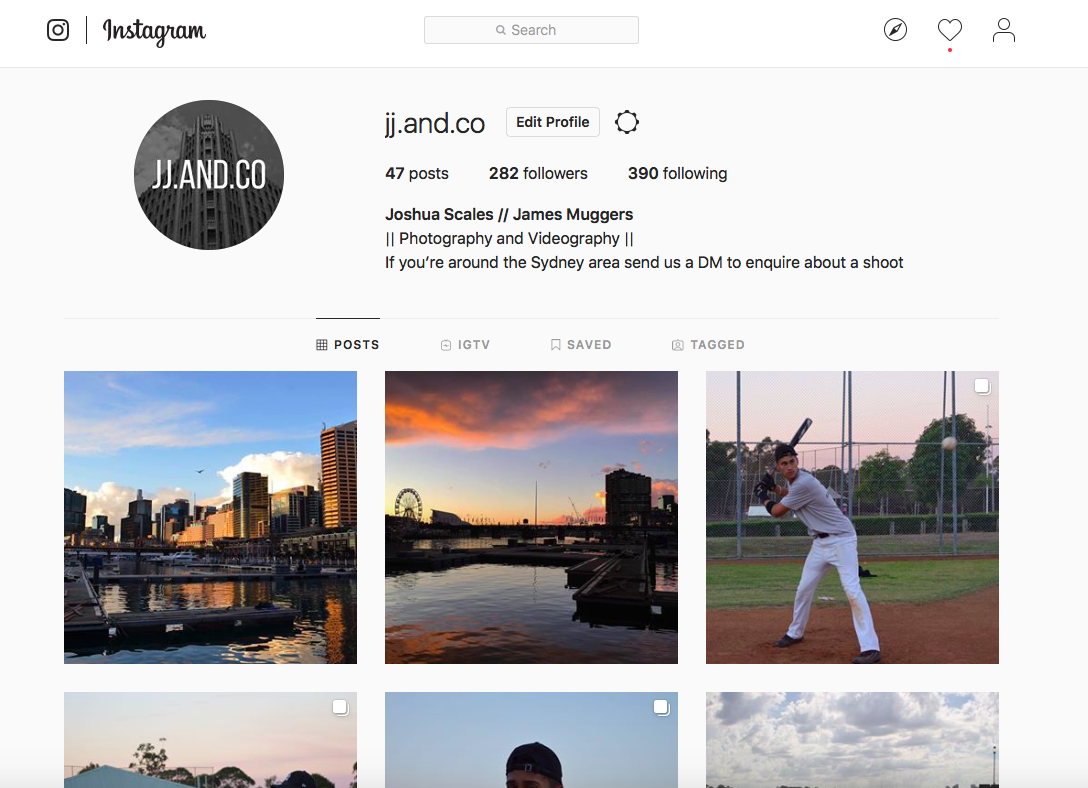
My Digital Artefact – JJ.AND.CO, incorporates photography, videography, blogging and writing. I intend to upload consistently and weekly across multiple platforms including Instagram, Youtube and WordPress.
I have been running a photography page for the past year and a half and intend to continue. Recently I have had to had a break due to HSC so this DA idea allows me to restart my passion for photography and even begin videography.
For my DA to stand out, I plan to give my own perspective on topics involving sport, trends and of course photography. Also to differ from other photographers, I plan to use different types of photography, not just sticking to one type. This includes – explorations, landspcape, portrait etc.
Through the ever-changing collosus of media, individual’s within an audience have been impacted significantly. In particular, when watching sport live, on television or streaming, technology has altered our visibility when watching a game.
“Sport has the power to change the world. It has the power to inspire. It has the power to unite in a way that little else does.”
Sport has brought upon power to the audience watching. Following a sports team empowers an indivdual. Especially with the uprise of media, following a team has become easier, this can be through social media or through the internet.
On the 24th of July 2014
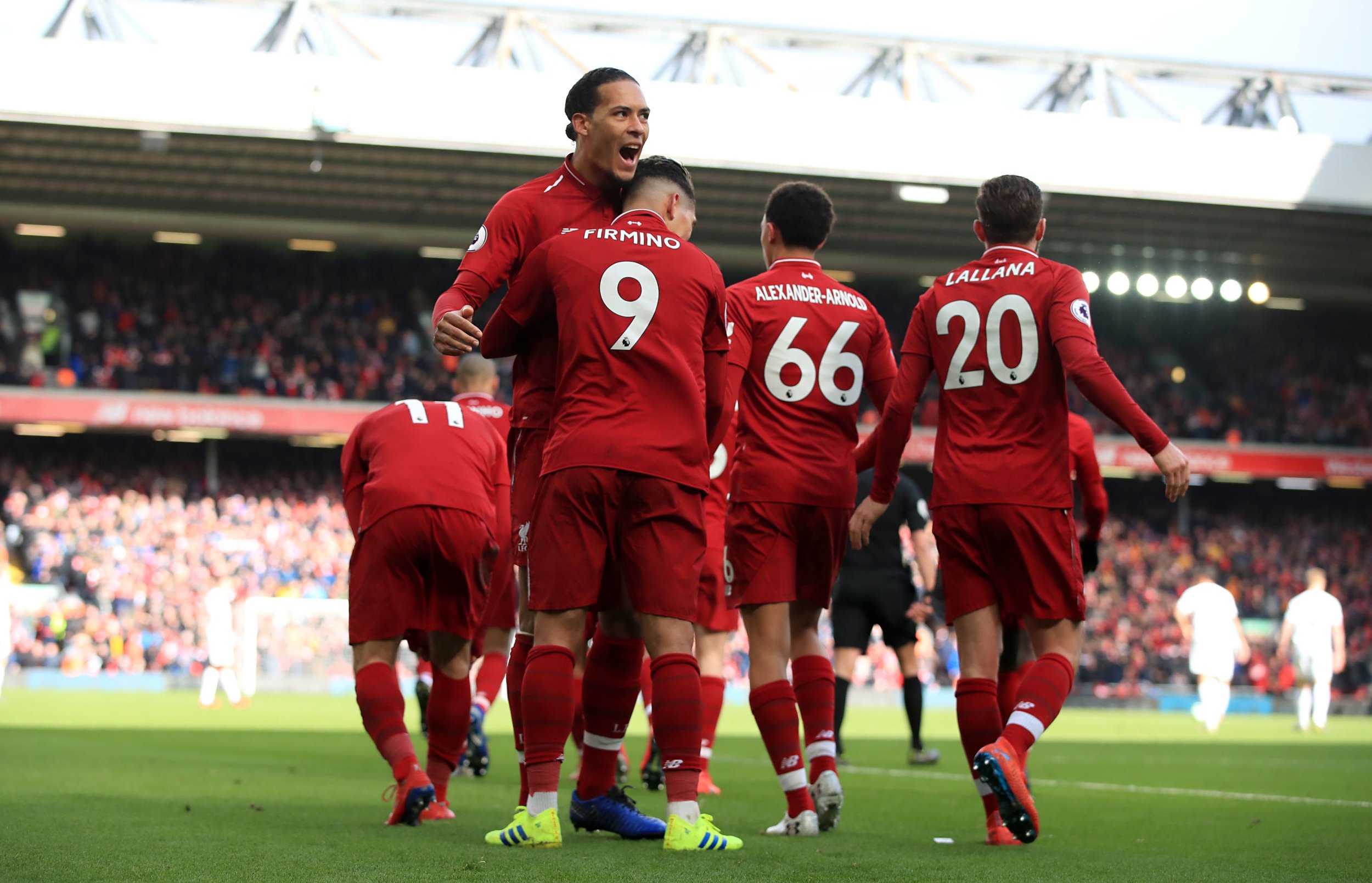
I visited Melbourne for the game between my favourite team Liverpool and Melbourne Victory. I had never been able to watch Liverpool play in recent times as they play in England and never have really came to Australia recently. The crowd was made up of around 95,000 fans at the MCG, mainly Liverpool supporters.
As Liverpool always do, they chanted the famous song “You’ll Never Walk Alone”. In a crowd of 95,000 people the feeling was surreal. It was as if I was dreaming, lying in bed dreaming of a time where I was so cold yet so warm at the same time.
Cold at the fact that my arms were lathered with millions of goosebumps which sent chills to my spine, yet so warm at the fact that my dream of watching my favourite team live was becoming a reality.
Every Saturday, Sunday or Monday morning at roughly 2am, my Dad and I would be sat glued to the screens for around 2 hours. At times we would be slumped, miserable at the fact our team has continued to fall short of winning a title or sometimes, we would be cheering. Cheering at the fact our best player, Mo Salah, had just scored an absolute screamer from outside the box. But no matter what we never gave up on our team, we religiously continued to support our team through thick and thin.
We never gave up.
The referee blew his whistle for the kick off and just like the game had started. The 95,000 audience members who were in attendance instantly threw up a huge roar. The sound was deafening. I had never heard a louder collective sound in my life. Once I regained my hearing the sounds did not stop. The crowd began to chant songs. Songs which would be chanted in the home side at our home ground, Anfield.
It felt as if I was standing in the middle of the Anfield Pitch, surrounded by the fans echoing their chants.
In that moment, I felt like I had escaped from reality and life’s problems. I was living in the moment and to me that was the most pleasurable thing.





 James Muggeridge
