BCM 112

A REDIRECTION FOR PERFECTION – THE VIDEO REVIEW SYSTEM IN FOOTBALL

As fans we have fallen in love with the beauty of our sports, and have dealt with the inconveniences which surround itself with these sports. Inconveniences such as referees not blowing the whistle for a clear foul or officials penalising our favourite players for a foul, which we believed, was not a foul. In our sports, whether its at a local or professional grade, we understand that referees make mistakes much like we all do in our daily lives.

However, sports have come to the conclusion that in our society, with the rapid innovation of technologies each year, that imperfection is simply not good enough. Technologies have been implemented to perfect such poor decisions.

Technology has brought upon plenty of beneficial aspects to the world of sport, whether it’s competing or viewing. Athletes are now able to be given objective feedback from their coaches to better their own game as well as the teams overall game. Technology has not only improved performance but has improved the safety of athletes. Athletes have been given better medical care and have been able to recover from their injuries at a faster rate than what they were without technology. Overall, technology has given the ability to pin point issues or problems in sports and has given an outlet to try and fix these concerns. However in an effort to fix these issues, sometimes technology tries immensely hard to perfect the game and thus works towards losing the beauty and intensity of the sports we love.

Welcome to my 2nd blog of my series delving into technology used in sports. This blog will focus on the issues which surround itself with the implementation of technology in football. Certain issues will be raised mainly around the audiences reception and sometimes the imperfection of technologies which overall have the ability to detract from the beauty of the sports we play and watch each day. I will look at an example of the referee review system used in football, the ‘VAR’.

The podcast segment of this blog will list all the current issues with the VAR in football, whilst the written blog segment will provide evidence into why these issues have circulated. Evidence can include the audiences reactions and scholars who have written articles on the topics.

VAR (Video Review System)

Video refereeing systems have been the focal point of discussion around sports for the past decade. Systems such as the VAR, DRS and basketball referral systems were brought in to perfect decisions which are sometimes wrong with the naked eye. However, the introduction of such technologies has only seemed to add confusion and irritation.

In 2016, the new FIFA president Gianni Infantino, introduced VAR and stated that it was “inevitable” that a piece of technology such as the ‘VAR’ would make its way into the world of football. In the modern day, a fan has comes to terms with the consistant need for referees and VAR officials to make apologies after a wrong call from a VAR check. The idea that VAR would be applied and automatically fix all “touch and go” referring decisions was truly a scam.

When introduced tp the premier league, VAR already had its enemies. Five premier league clubs were opposed to the introduction of VAR. However in the 2018/19 season, the system was implemented. Players and coaches had their say as decisions were overturned as the margins of these decisions were so tight and thus left players, coaches and fans irritated and confused.

In my podcast I presented statistics which showed the recent data of VAR decisions. In concluding these statistics, I found that there was an obvious problem with the amount of decisions overturned. Overturning decisions creates a sense of irritation for not only the players and staff, but the fans. Now with the current state of the game, fans cannot truly celebrate without witnessing the VAR check.

In a study conducted by ‘Statista, (providers in marketing and consumer data) it showed the opinion of 1419 people from the British public on how successful the VAR system was in the 2019/20 season. Data showed that 10% of the total surveyed rated VAR a 0 out of 10. The rating with the highest percentage was 3 out of 10 with 15%. This study obviously doesn’t speak for the footballing world, however, it does give a glimpse as to how the VAR has been received in Britain.

In a poll created by the ‘BBC’, it showed that only a third of fans were convinced that VAR was improving the game. On the other hand, 40% of people surveyed said that VAR was ruining the game. BBC sport is one of the leading journalism websites in Britain, therefore, this survey provides a more accurate view of VAR in the English Premier League.

Here are some of the games best ever moments which would’ve been overturned if VAR had a part to play:

“The introduction of goal line technology removes contentious goal line decisions which might influence the match day atmosphere and supporter satisfaction. Even though technology may minimise bad decisions being made, football supporters may actually miss the debate which stem from refereeing decisions and which contributes to the overall experience for football supporters”. – Mathieu Winand, Professor of Sport Management and Head of Department of International Sport Management at LUNEX.

The question which people must ask themselves is whether they want the correct decisions or a fast and free flowing game which isn’t riddled with confusion. A question which I ask myself is if VAR was applied since the start of football, would we even have a game now?

In answering my question, “are we losing the beauty of our games”, I do believe that we are. However, in doing this we have received a 5.5% increase in correct decisions awarded. So whats next for the future of the VAR? This question will answered in my next blog as I will predict the future of football through reference to media futures articles and scholar articles.

JAMES MUGGERIDGE

LIVE TWEETING PART 2

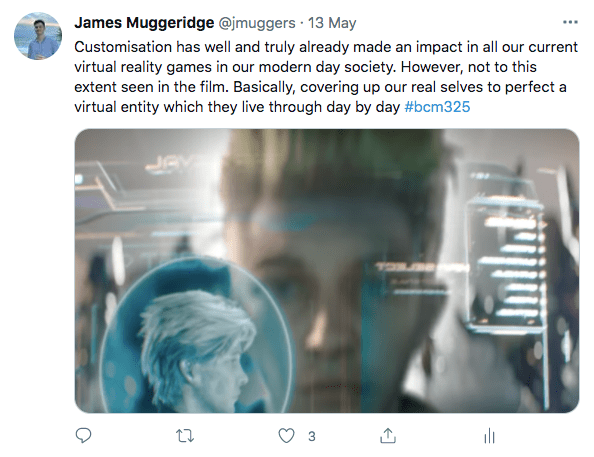
Continuing on from my last live tweeting summary, I have tried to be consistent with my tweets relating them to future media and lecture readings. I have also continued to share content by peers which I believed to be core to future media studies and which have appealed to myself personally. Part two of my live tweeting summary blog will incorporate my tweets on some of the most prolific sci-fi films in film history such as ‘The Matrix’ and ‘Blade Runner’. A movie which I personally enjoyed tweeting about was Ready Player One. A visually appealing movie which predicts a future that we are working towards. A society which uses virtual reality to cover their own imperfections as seen in popular customisation games such as GTA and Skyrim.

BLADE RUNNER

A film set in a dystopian society which is corrupted with both environmental and economic issues. As the world continues to battle with global warming and pollution, the movie creates subtle prediction for the future of our society. In the first scene, K arrives at his destination to detain a rogue replicant. The setting describes a desert with no crops and no civilisation in sight. 

“One thing I’d say is that if anything the future will be more remarkable than any of us can imagine, because although any of us can only apply so much imagination, there’ll be thousands or millions of people using their imaginations to create new capabilities with these future technology powers.” – Ray Kurzweil.

Blade Runner emphasises Kurzweil’s theory where he discusses the potential of our future with the continuing innovation of technology.  Denis Villeneuve directs the movie predicting a variety of technological advancements in an imagined sense. The film provides no limit on the futures potential for outrageous innovations which we can only imagine currently in our modern day society.

The films highlight K’s transformation from being a slave replicant hunter to a humanised android who battles between doing his job and covering the fact that his kind, bioengineered human androids, are able to reproduce. If humans were to uncover this, there would be war.  

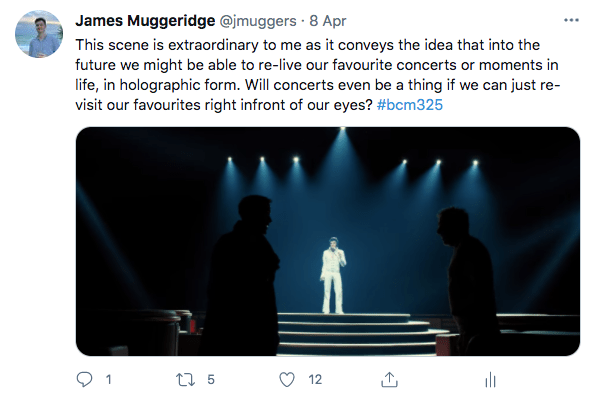
When K finds Rick Deckard, they battle until they tire. This battle ends while a simulation of Elvis Presley’s concert plays in the background. This scene works to potentially predict a life where we can simulate our favourite concerts in front of our own eyes and in the presence of our living room.  Once the battle has ended, K and Deckard enjoy a beverage together. 

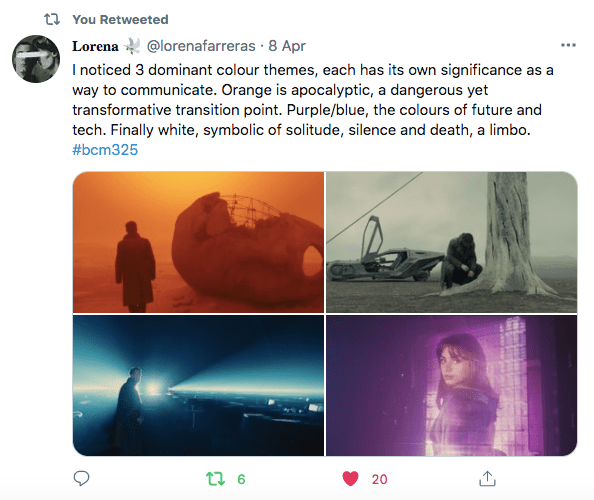
A post which was personally intriguing was Lorena’s post on the idea of using three dominant colours to set moods and scenes. Each colour described their own scene and thus allows the audience to feel emotionally connected through colour.

The movie also emphasised music as a way of portraying a scene. In the scene pictured below, the music is very dramatic whilst also being quite soothing. Sets a perfect mood for the scene as K and his android partner embark on their journey whilst the rain pours down around them.

THE MATRIX

As a film touted as one of the best sci-fi films of our generation and a film which has catalysed the sci-fi genre’s popularity, the film delves into the possibility that there is an alternate dimension behind our normal life.  

“As we are still lacking a “theory of everything”, we cannot rule out the possibility that novel physical phenomena, not allowed for in current physical theories, may be utilised to transcend those constraints”Nick Bostrom

The film, ‘The Matrix’, shows that with this ever-changing world we live in, anything is possible. As Bostrom states, “without a theory of everything”, we cannot tell at what degree the world will transcend beyond our current capacity.

The film started the use of ‘bullet time’ technology which slows camera shots down to intensify and amplify a fight scene. This camera techniques is used in most sci-fi films and poses the question as to what kind of camera shots will be used in the future of film in a technological world which is ever-changing.  

The film boast plenty of cultural and biblical references. Such referneces inlclude the reference to Simulacra and Simulation by Jean Baudrillard and the allusion of morpheus as a god.

Simulacra and Simulation by Jean Baudrillard, is referenced at the start of the film as Neo picks up the book by his doorway. The book is also referenced when Morpheus shows Neo the “desert of the real”. The film explores theories from famous philosophers and because of the emphasis placed on such theories, the Wachowski brothers made all lead actors read books including Simulacra and Simulation by Jean Baudrillard, Out of Control by Kevin Kelly, and Introducing Evolutionary Psychology by Dylan Evans.

The biblical referencing of Morpheus refers to his gold like figure. The Wachowski Brothers based Morpheus on such readings about the god Morpheus. This is seen through Morpheus’ role in the film to awaken people from their dream states to reality. In Greek mythology, Morpheus is labelled the god of dreams, highlighting the comparison.

ALITA: BATTLE ANGEL

‘Alita: Battle Angel’ tells a story of a washed-up android who is found by a doctor by the name of doctor Dyson. Alita is built from scratch and as she spends more time with humans, discovers her hidden battle attributes.

“A Cyborg is a cybernetic organism, a hybrid of machine and organism, a creature of social reality as well as a creature of fiction”. – Donna J. Haraway

With social interaction, Alita journeys on a coming of age transformation where she begins as a quiet and confused cyborg, changing into a confident and social cyborg. However, mentioned it above, it is important to note that she will always be a “hybrid”. Alita transforms with social reality while also being well aware of her cybernetic tendencies.

Much like ‘The Matrix’, ‘Alita: Battle Angel’ started the revolution of “motion capture technology”. This is where movement of characters are digitally recorded and thus giving computer animators the power to make non-human characters more life-like. Films such as the ‘Polar Express’ used this technology, however, for an animation film. ‘Alita: Battle Angel’ used this piece of technology for an animated character in a movie with real-life characters. This concept was then applied with ‘Avatar’ and the character ‘Neytiri’, thus paving the way for more movies to adapt this technique.

Much like films we have screened so far such as Space Odyssey with H.A.L and Westworld with ‘gunslinger’, Alita becomes more humane as the film goes on. However, this comes at a cost as Doctor Dyson decides the limit Alita of her true capacity and restrict her from venturing out into the city. This is where the audience must decide as to whether Dr Dyson is restricting her from her true potential or he is protecting her from the dangers of the outside world.

Whilst showcasing popular themes such as humanising of androids and replacing loss with a new form of robotics, ‘Alita: Battle Angel’ also raises a common concern for people around the world, the inability to fit in because of difference. Alita is obviously different and this means she is targeted by those who are jealous and hungry for power.

READY PLAYER ONE

‘Ready Player One’ portrays an environment which is post modern yet keeps in touch with the current concept of cyberspace. An environment which is imaginatively limitless and has endless potential.

As mentioned in my opening paragraph at the top of this blog, ‘Ready Player One’ is my favourite screening to date. Whilst it faced negative feedback from its critics (mainly due to the book before it), the film shows a scarily accurate depiction of what the world is coming to.

Giving the ability for people to neglect their surroundings and focus on their in-game character offers a dangerous result. When protagonist Wade Watts finds the first key to a potential company-winning prize, he is targeted by a corporation lead by evil character Sorrento who is hell bent on winning the overall award. Through customisation, it can be seen that Sorrento develops a large and intimidating character who has perks of his own. Wade creates a character which isn’t powerful or special in any shape or form, however, he wins the keys based on his own wit and intelligence.

The film overall predicts a dangerous future where if you are succeeding in the virtual world, people who are more powerful in real-life will hunt you down.

In this tweet I shared by Josephine, it discusses my points mentioned above. Cyberspace acts as “the place between”, however, actions in this cybernetic world can hurt your real-life form.

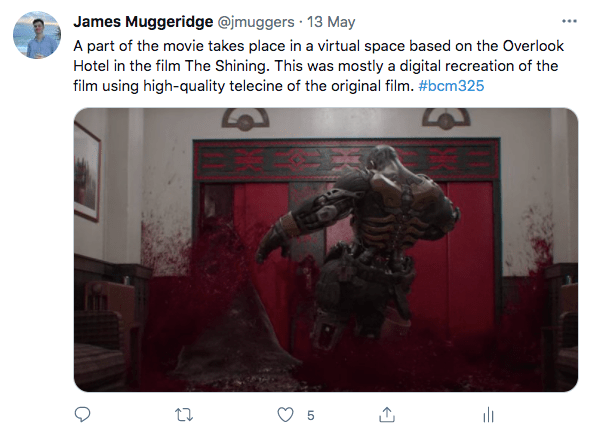
The film presents plenty of pop-culture references, appealing to the overall film and game lover. Spielberg uses a digital re-creation from the film, ‘The Shining’, as seen in the tweet below. Wade’s in-game partner, “Aech”, is clearly scared of horror films as he then finds himself in the Overlook Hotel where the Shining is based.

PEER REVIEWS PART 2

BACK TO FASHION – LIA KIM

My first BETA video I will looking at is Lia Kim’s fashion and lifestyle project. From my knowledge, Kim’s initial idea was to post weekly vlogs and base her videos on the culture of journalling and surveillance.

Adopting a project on fashion links significantly well with the future media subject and the screenings watched so far.

Lia sourced inspiration from the ‘Ghost in a Shell’ screening where she liked the aesthetic of clothing worn by characters. Not only did she source inspiration from films such as ‘Ghost in a Shell’, however, this made her have another look at previous films and identify whether there were any other fashion option she could talk about. I thought this was a great way of providing a future studies correlation to her fashion based vlogs. I could also identify that Lia had used her public utility well. Using twitter as a feedback loop allows her to gain insight from her audience and even peers from the subject.

I proposed two articles on the future of fashion and in specifics, the future of sustainable fashion. This concept is the first thing that came to mind when I thought of the future of fashion and something which is so important with the current environmental climate. The first article was an article written by Amanda Cotler and published by Forbes. It incorporates a summary of sustainable fashion with a future of fashion and what people can do to make sure sustainable fashion is something which is present in the future. Along with this article I added an education scholar article by Thomas Radclyffe called “Designing a sustainable future through fashion education”. This article adds another form of background research and gives evidence to how important fashion education is in providing a sustainable future.

In concluding Lia’s project, I want to emphasise her outstanding knowledge of fashion and the future media study. Her project seems to be well thought out with a clear plan in place and clear view of the future of her project.

ROBOT AND MEDICINE – JORDAN ARLENGHI

The idea behind Jordan’s project was to develop a 3D a robot/machine to carry out medical procedures. The project would look fifty years into the future which works well with the screenings so far as they too predict the long term future.

I admired Jordan’s idea for this project as it works towards benefiting the future of medical health care. Seeking workers for health care has been on the decrease, therefore, it is vital that we look at what the future will mean for health care and whether developing robots to operate medical procedures is the next step.

My advice for Jordan would be to read up on lecture readings and clearly plan out his project plan. There are plenty of recourses which Jordan can use from the cyborg lecture as well as the cyberspace lecture. Planning out his project will help with the development of his robot.

To help Jordan I linked an article which I found to be insightful into developing robots for medical care. At the beginning it emphasises how useful these robots will be once coded and developed in a way which will benefit caring for injury, sickness etc.

Furthermore, I located an article linked in week nine’s lecture notes by Clyne and Kline called ‘Cyborgs and Space’. I though this article would be insightful towards future media studies. As well it linked with Jordan’s topic of developing robots and developing them for a whole new environment.

I enjoyed reading Jordan’s blog and watching his DA Beta. I learnt a lot about robots and he presents an interesting project which I haven’t seen from anyone else.

FASHION FEVER – GRACE MARY BOULATOUF

Similarly to Kim, Grace is adopting a fashion project where she will look at how large fashion companies and institutions are poor for the environment and thus the future.

Grace is using YouTube as her platform to distribute three short videos. The first will be a summary. Much like Grace, I also made my first blog/episode a summary. This allows her audience to read up on her concept, topic and idea going further with her project. The second episode will be all about SHIEN.

‘SHIEN’ is known for having a threatening and damaging impact on the world. Grace will look at why the brand is one of the worst fashion brands to date. In researching SHIEN and trying to understand what the current issues were with SHIEN, I came across article which provided an extensive research into why SHIEN is problematic and what needs to be done. This is something which I though that Grace could utilise for more background research.

The next article I sourced for Grace’s benefit was an article on how we as fashion consumers can keep fashion environmentally sustainable. It emphasises the importance of keeping fashion environmentally sustainable especially with the current climate as the world is suffering from the continuing issues such as pollution.

The last episode in Grace’s project will focus on fast fashion’s production. In particular she will look at the next 10 years of fast fashion and how it may develop and change.

Overall I like how Grace narrowed her focus down to a niche as well as the background research which she has done shows that she has a well thought out plan for this project.

DA BETA

My DA involves the investigation of technology in sports and whether the continuing innovations of such technologies will detract from the overall beauty of certain sports into the short term future.

My project will consist of:

  • 4 blogs
  • 4 podcasts
  • 1 final video compiling all research and points raised

I have only posted one blog and podcast on an overview of sports technology so far. This would aim to provide a good basis to start my project. I am currently in the works of writing an issues based blog which would look at everything that’s wrong with sports technology and what it could mean for the future.

Something which I didn’t have time to talk about in my Digital Artefact beta was my user feedback. I only posted my first blog on twitter but I intend to share my following blogs and podcasts over a select few other social media platforms. I received plenty of helpful comments on my pitch video which will be applied in my future work for the project.

JAMES MUGGERIDGE

TECHNOLOGY IN SPORT: AN OVERVIEW

My first episode of my BCM325 podcast series regarded an overview and a brief history of the technological use in sport. I discussed my plan for the series as well as delving deep into my overarching question as to whether there is any need for technology in sport if it results in negative outcomes and uproars.

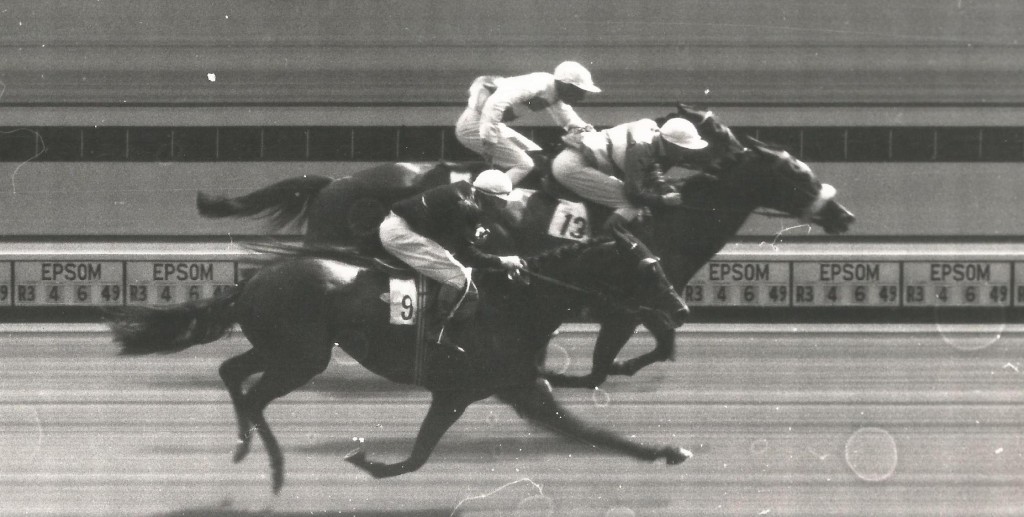
Technology was first used in sport in the form of photo finishing in horse racing. The idea behind implementing photo finishing in horse racing is to provide a clear camera angle (located at the finish line) to pinpoint the winner in a tight finish which cannot be decided by the naked eye. In a sense, this innovation has paved the way to a revolution of not only photo finishing technology, however, technology which can pinpoint a close decision through specific camera angles and technology. Examples of these types of technologies include hawk eye, goal line technology and the use of photo finishing in not only horse racing, but in Olympic sprints.

Sports science technologies were next as they were implemented as a way of reading heart rates and therefore athletic performance. A significant advantage of using such wearable technologies is the fact that it provides a real time analysis from real time performance. It is a convenient way of gaining data straight away and thus providing feedback to the athlete on where they must improve and where there strengths are. Wearable technologies such as sweat analysis are not only used to read data on athletic performance but is a way of preventing any current or future injuries. An example of this is gaining data of an athlete which shows that they have an abnormal heartbeat. Gaining this data allows for the coach or manager to properly administer the right treatment plan to lower the athletes heart rate and continue training.

Sports technology has proved to benefit the world of sports when you look at where certain sports have transformed since their origination.

For example, on a global stage, the Olympics have profited of technology on a significant scale. As mentioned before, the use of photo finishing has significantly made tight decisions much easier. As well as this, the viewing of events such as the 100m race or the hurdles have been made more intense and exciting to watch. Sprint athletes have also benefited off speed guns which show the speed of there races and allow for the goal of continuous progression.

Wearable technologies have benefited performance whether it’s short or long range athletics. Heart rate monitors and the 21st century innovation of the Garmin and Apple watches, have allowed for coaches and athletes to read real-time data from there performances and practices.

Another example of a sport which has made significant progression since its origination is cricket. Cricket begun with the use of a stick and ball. A game which was played as early as 1611 in England Villages. The sport was named a ‘boys sport’ and when looking at the modern game of cricket, this definition has well and truly been eradicated. Bats have become stronger and boundaries have become smaller to suggest that the game is becoming a ‘batsmen’s sport’.

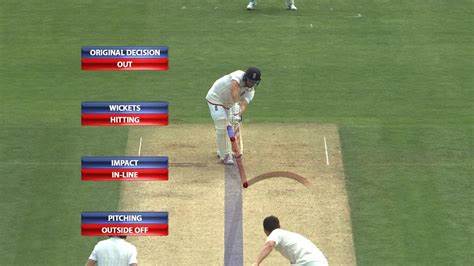
When looking at its technological progression, however, it’s hard to miss the saturation of sports technologies used throughout the game to perfect the overall sport. The stumps are now implemented with a stump mic and there are technologies which pick whether batmen have hit the ball or not (For example, the Snickometer). Hawk-eye can be used to perfect the LBW (leg before wicket) decision, lighted wickets allow for umpires to be notified when the bails have been dismantled and the introduction of the Duckworth Lewis System calculates a team total in the event of an unfortunate circumstance such as bad weather.

When looking at an overview and a brief history of sports, it’s hard to notice any of the negatives which flood the world of sports. However, as sports around the world have now become saturated with technology, there are bound to be negatives and issues which come with it.

In the next blog I will list some relevant and topical issues with specific technologies and debate whether these technologies listed are truly needed in these sports. This will lead to my overall question as to whether technology is damaging the beauty of our game and what needs to be done into the future to stop this.

JAMES MUGGERIDGE

LEARN AND REVISE: DA PEER REVIEWS

The art of divination is a sacred act of predicting an unseen or un-forecasted events. An act which to this day can be applied to foreshadow the possibility of negative occurrences, allowing the ability to act and stop such events. My DA involves divination in some aspect as I must predict, backed up with research, a future which either involves or does not involve the use of technology in sport, to prevent a future which spirals out of control.

With this in mind, I have gained motivation to analyse a selection of sports before and after their technological boom to predict a possible future which includes technology or no technology. This in turn will hope to take out the negatives and issues revolving around the current circumstances, and raise hope for a future of sport which focuses on both the correction of the game and the entertainment factor.

When revising my peers, I have learnt new components of a successful project that I may of missed during my pitch. Divination is one which I will incorporate into my project.

DA 1: Is productivity-improving technology making us less productive? – Emma

The first digital artefact that I will be looking at is Emma’s project on whether productivity-improving apps are improving our productivity or making us less productive.

Emma clearly displays her concept clearly both in the blog and in the pitch. Beginning her pitch with a rhetorical question attracts listeners to feel involved and appeals to the emotions. In terms of utility, her digital artefact is relevant and must be talked about in a modern day society fuelled by the increase of technology aiming improve productivity.

I advised a website portraying the negatives of productivity-improving apps, in particular Tik Tok. I feel like this something which could be utilised to Emma’s advantage for background research.

As well as this, I linked a page on an overview of auto-ethnographic research. Even though we did study this in the previous semester, I thought a refresh on the topic would only benefit her understanding.

Finally, I sourced a Ted talk on the book which Emma is intending on reading as a basis to her digital artefact. This will work to showcase a raw and unedited view from the author Barry Schwartz.

DA 2: The Future of Beyond Branding – Amy

The next pitch I briefed was Amy’s blog on the future of her design company, ‘Beyond Branding’, and where studying BCM325 will take her in the future of her company.

I commended Amy on her ability to set clear and concise goals, something which is significantly key and also something I must work on. As she is using the semester to expand her already successful business, I sourced an article on some tips for conducting an interview.

I also suggested a reading from Wendell Bell called ‘Making people responsible’. The reason for this was to emphasise the importance of looking into the future and as Amy is focusing on the future of her business, I believed this would be an ideal article to read.

DA 3: AR & VR Technology Changing the way we Shop Online – Alicia

Alicia focuses on the future of online shopping, what has been done already and what can be done to better the experience for customers through the use of AR and VR technology.

Alicia’s blog has a great layout, including bold sub-headings which makes the blog easily understandable and personalised designs which creates a sense of individuality. I’ll also add that I was impressed with the ability to include the FIST principle into the digital artefact allowing for the capability for variation.

I recommended an article on the best video essays of 2020 for help on making her video as good as possible. This article mentioned reasons for why the videos were the best which may guide Alicia towards a successful digital artefact final project.

My second recommendation was a YouTube video made by a fashion blog called ‘Electric Runway’. It talks about the impact which AR and VR technology will have on the future for the fashion industry. I thought that this may help as it is created by a fashion author with experience in the field.

LIVE TWEETING SUMMARY

Personally, live tweeting during the screening has been a fluctuating experience. There have been tough periods where I have struggled to come up with anything useful and there have been other times where I feel like I have thoroughly grasped the content.  

All movies screened so far have been intriguing. I have tried to analyse film techniques used throughout and connect these techniques with the study of future media. Techniques which have stood out to me have been the use of music, colour and lighting. These techniques were so valuable to any science fiction film to set scenes and convey messages, especially without the use of today’s technology.  

The first screening was ‘Metropolis’. A film, directed by Fritz Lang, based on the Weimer era in Germany where the country was in political and economic turmoil. The protagonist, Freder, shares a conflicting relationship with his father whilst finding hope for a better society in the form of his love interest and the mediator, Maria. 

Inadvertently Maria is a character which undergoes significant change. A scientist by the name, Rotwang, makes a robot version of Maria which works to create an uprising of workers against the city. In a scene which shows wealthy men stimulated towards the new ‘robot maria’, an influential figure is created. 


A common theme shown throughout the four films watched to date is the fact that all films have acted as catalysts for the science fiction genre. Both Metropolis and Space Odyssey shared a connection with Star Wars.  

As pictured above the sketch of C3PO was influenced by Metropolis as well as the stagnant camera shots used in Star Wars of the spaceships slowly moving, were clearly drawn from the Space Odyssey. 

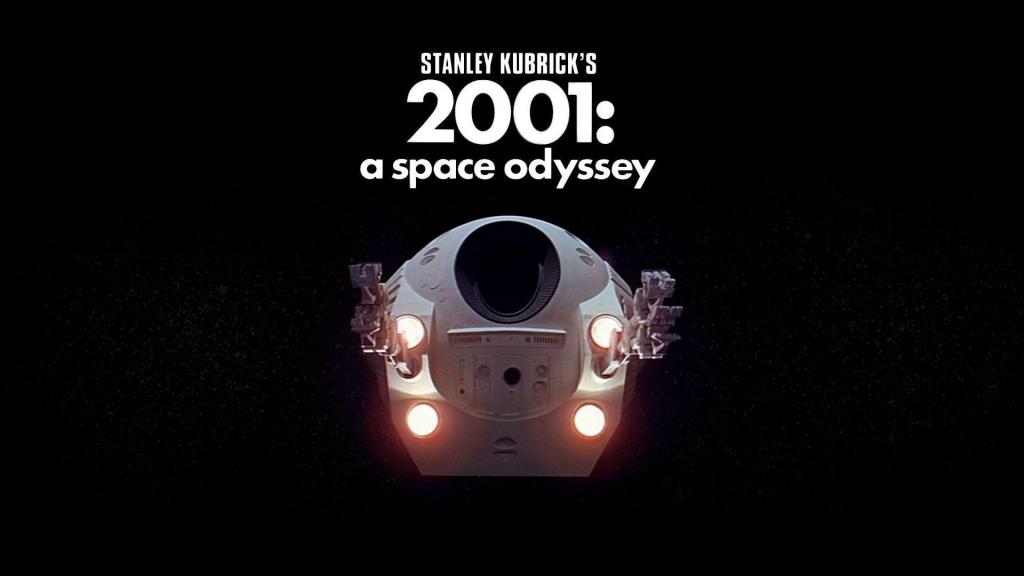
‘2001: A Space Odyssey’ is a film produced by Stanley Kubrick about a space voyage gone wrong when an AI becomes overpowered and tries to manipulate Dr David Bowman. The film is known for its incredibly accurate prediction of space flight and the potential ability for AIs to takeover humanity. 

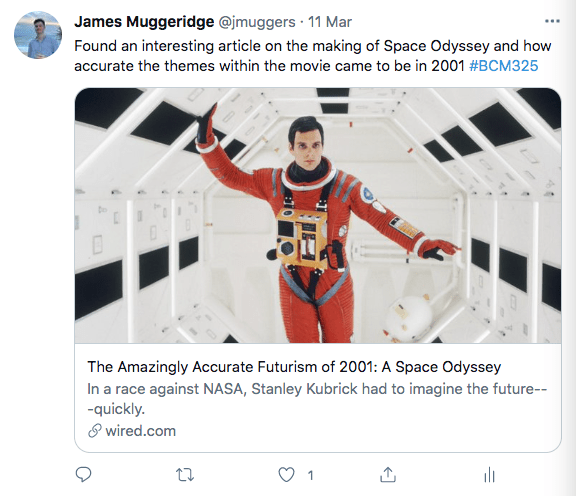
For background research on the movie, I found a website which showed how accurate the predictions made in the film came to be in today’s world. Before watching screenings, I made sure I researched the films beforehand. This already gave me an upper hand when pre-generating tweets and even creating tweets on the spot. 

Even though tweeted for satire, I found it interesting to think of what deliveries would look like in the future. Watching this film gave myself a right to think about what the future of our generation could be.  

A successful tweet of mine which had pretty good engagement was the tweet pictured above. In arguably the best of scene of the film, Dave finds himself going insane. Kubrick’s use of colour joined together with creepy music emphasises the dramatic and confusing nature of the scene. A scene which has acted as a catalyst in today’s films such as Interstellar as Mathew Mcconnaughey goes insane towards the end of the film. 

On a similar note, the movie ‘Westworld’ attempts to portray the same connotations as Space Odyssey. The film takes place at a theme park which is made for the wealthy. However, whilst the protagonists start to take advantage of the park, the androids start to rebel against the coding initially developed for them.  

From punching bag to the terminator, Gunslinger rebells against the normal coding at the theme park and hunts down both the two protagonists. A sign for the future, much like ‘H.A.L’ in Space Odyssey and the ‘Puppet Master’ in ghost in a shell.

Behind the scenes of the Theme park there are workers who make sure everything runs smooth. This division between workers and the wealthy easily compare with the same division between the factory workers and the wealthy in Metropolis. 

As well as this, I connected the workers to the game creators in the hunger games (also received a comment from a BCM peer about the resemblance with the Truman Show), emphasing the influence of the film on movies in today’s society.  

Starring Harrison Ford, the film ‘Blade Runner’ stays the with a consistent theme of humans against machines. ‘Blade Runners’ are humans who are payed to hunt ‘replicants’ or androids. The replicants start to gain human-like qualities, much like both the Space Odyssey and Westworld. 

The achievement of human like qualities is an example of a prediction made by Ridley Scott and the prehistory of the future. Once gaining these qualities, robots or androids rebel against norms and thus reverting back to the prehistory of the future, bring upon negative qualities.

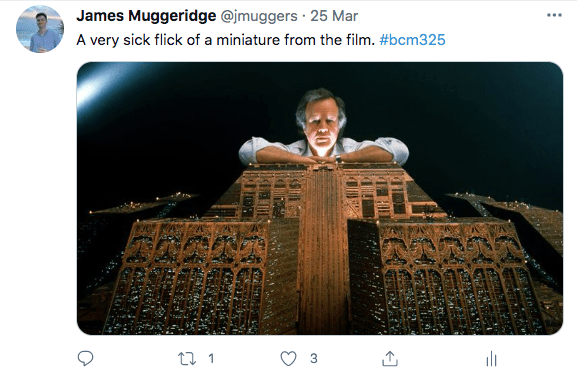
An interesting aspect of the Blade Runner film is the techniques used to make the film. Ridley Scott made miniatures of the pyramids to bring them to life. A crazy idea which turned to gold as the movie became a sci-fi classic, however, is not normally used in the modern day as visual effects are approached with digital editing.  

‘Ghost in a Shell’ is an amine movie which has influence the way in which we watch sci-fi movies today. It follows a security agent, “Motoko”, who hunts an allusive hacker named the “Puppet Master”. A film which challenges self identity in a futuristic setting.

As mentioned above, “Ghost in a shell” has influence many movies in our modern day society. In particular, the Wachowski’s (creators of the matrix) sited this movie as inspiration towards the Matrix. It’s quite easy to see as both films home in on the question of what is real and what is virtual.

Finally, an interesting tweet which I had to retweet about a prediction made in A Ghost in a shell, which as come to fruition. Our modern day society is overwhelmed which the high concentration of social media and ads. This also acts as divination as it warns us as the audience of an imagined future with negative outcomes, shown through the rust on the advertisements.

IS TECHNOLOGY DETRACTING FROM THE BEAUTY OF SPORT? BCM325 PITCH

As a sports fan it has become a reoccurring theme to hear about backlash in the aftermath of a ‘wrong’ call made by an offical. Technology has been implemented into sports competitions around the world in an aim to perfect any issues revolving around live calls made my officials. However, in doing this, it is argued that some sports have lost their touch and focusing more on perfection than entertainment.

Welcome to my DA pitch where I will aim to delve into the impact of technology in sports and what it means for the future of sports in the short, medium and long term. My Digital Artefact will include a series of blogs and conclude with a Video Essay.

JAMES MUGGERIDGE
BCM206 CONTEXTUAL ESSAY

RANSACK SPORT

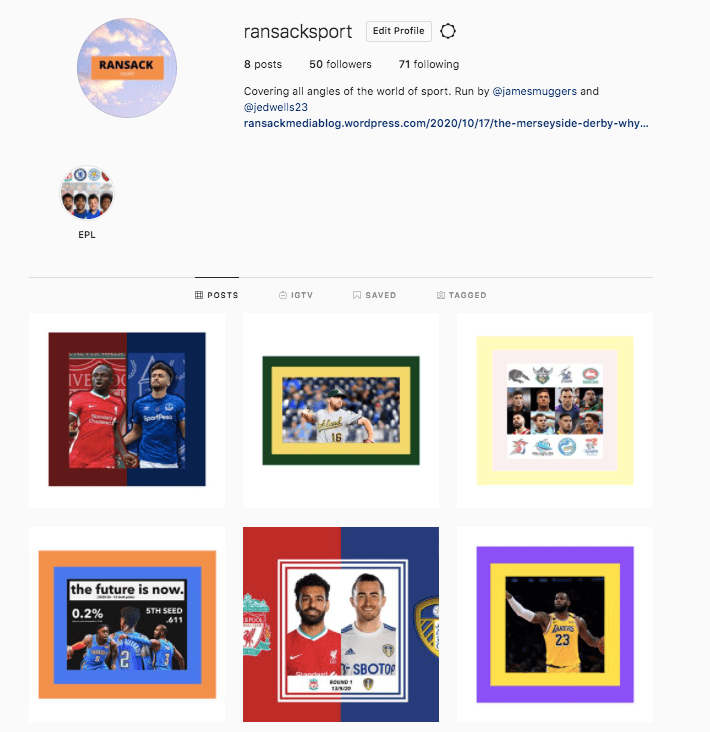
Ransack Sport is a DA which I started stemming from Ransack Media. Ransack Media is run by a group of inspiring journalists writing on topics such as entertainment, politics and sport. I branched out from Ransack Media, while posting my better articles on the main site, to create a niche account which appealed to a sports-based targeted audience. Ransack Media distributes content on Facebook and Twitter whilst Ransack Sport only distributes off Instagram. The goals for this new account were to build my following by posting sports articles.  

Through prior knowledge of BCM degrees I begun to prototype what types of content I would start to post. I decided to start with a post on the EPL as it had just finished, and I had a post which was written up already. This started things off smoothly as next I decided to post an NBA article showing that the account was not just for football but for multiple sports. I continue through the ideation stage posting content weekly with a methodological process.  

To try and gain a following I tried different techniques involving all Ransack accounts. I applied hashtags to gain a following from elsewhere. For a while iterated by posting weekly content. I chose not to focus on a particular sport to broaden my spectrum of newswriting. I distributed the best posts on the Facebook and the twitter accounts which would try to bring any new followers. These posts were shared on my own account and from the other members in the groups’ accounts. 
 

The social utility of my content was that it was relevant to start. The EPL season had just started and the NRL season was nearing to an end. This was perfect as I could write both match reviews and previews for each sport as the seasons were in full effect. The idea behind the account was to make it visually aesthetic as there aren’t many ‘aesthetic’ accounts out there which post on all sports. Making the account visually aesthetic conceptually would have drawn in the attention of other followers (Kane, 2019).

I do believe I can continue this DA after this semester as it is something I genuinely love doing. During this semester it has become a hobby, however, as this semester is ending, I have had trouble keeping up with weekly posting with other assignments to do. Something I have also lacked is motivation. I have said that I would do things that I just haven’t got around to doing which has limited the potential of this DA this semester.  

Overall a learning curve for myself as I have discovered that increasing engagement and following is hard to do without a proper planning stage. This is just the beginning of a DA which I will look to continue into the future creating a portfolio for myself.

James M

Instagram – @ransacksport 

Facebook – Ransackmedia 

Twitter – Ransackmedia 

EP4 EPL VS A-LEAGUE SOCIAL MEDIA

COMPARISON

Hello and welcome to my final episode on my podcast series on the social media use of the EPL and the A-League. I’m going to be honest as I probably set out to do 5 episodes instead of 4 however with time constraints, I have decided to only do 4 podcasts.  

Just a recap on the series, Episode 1 was an introduction on what to expect, Episode 2 was on the EPL social media use and social and cultural transgressions of the league and Episode 3 was on the A-Leagues social media use, the adoption of premier leagues features and the negative side of being an Australian Footballer.  

This episode will look at how the two compare and where both can adapt features from each other.  

As mentioned in my introduction episode, I have experience with both leagues. Being a supporter since birth of both Liverpool and Sydney. I have also known the significant difference in talent and culture. EPL started hooliganism and ended it while the A-League with the emergence of new team Western Sydney Wanderers have brought it back into the game.  

However, in terms of social media, the A-League has as mentioned adopted features from the EPL. These features are the photography elements, transfer talks and the ability to promote their teams on social media by personalising their accounts.  

The A-League must adopt the ability to be more interactive with their audience. There is an obvious difference in feedback from the comment section. This may be due to the difference in overall followers; however, A-League still must be more interactive. Simple stuff like using more rhetorical questions and inviting audiences to comment on transfer news or any updates. A lack of fan art is quite easily seen which makes the EPL so significantly dominant when talking about audience interactivity.  

The EPL could look at adopting a more cultural approach. The A-League posts Spotify sounds which is Australian-based, and this could be done by the EPL which such a prominent grime scene.  

The EPL is known as an organisation which is promoting their stand for the fight against racism. The A-League of recent has had an issue with the battle with online abuse against players. Both prominent issues worldwide however its safe to say that the EPL are currently dealing with the issue of racism further than of the A-League. The EPL has culturally and socially trasngressed while the A-League is already culturally diverse and haven’t had too many problems with such an issue.